Announcing Blue Weave
We're building a synthesiser.
That's a turn for a game studio, so here's the short version of how it happened. Our games needed sounds, so we wrote something to make them. The something got better at it than we expected.
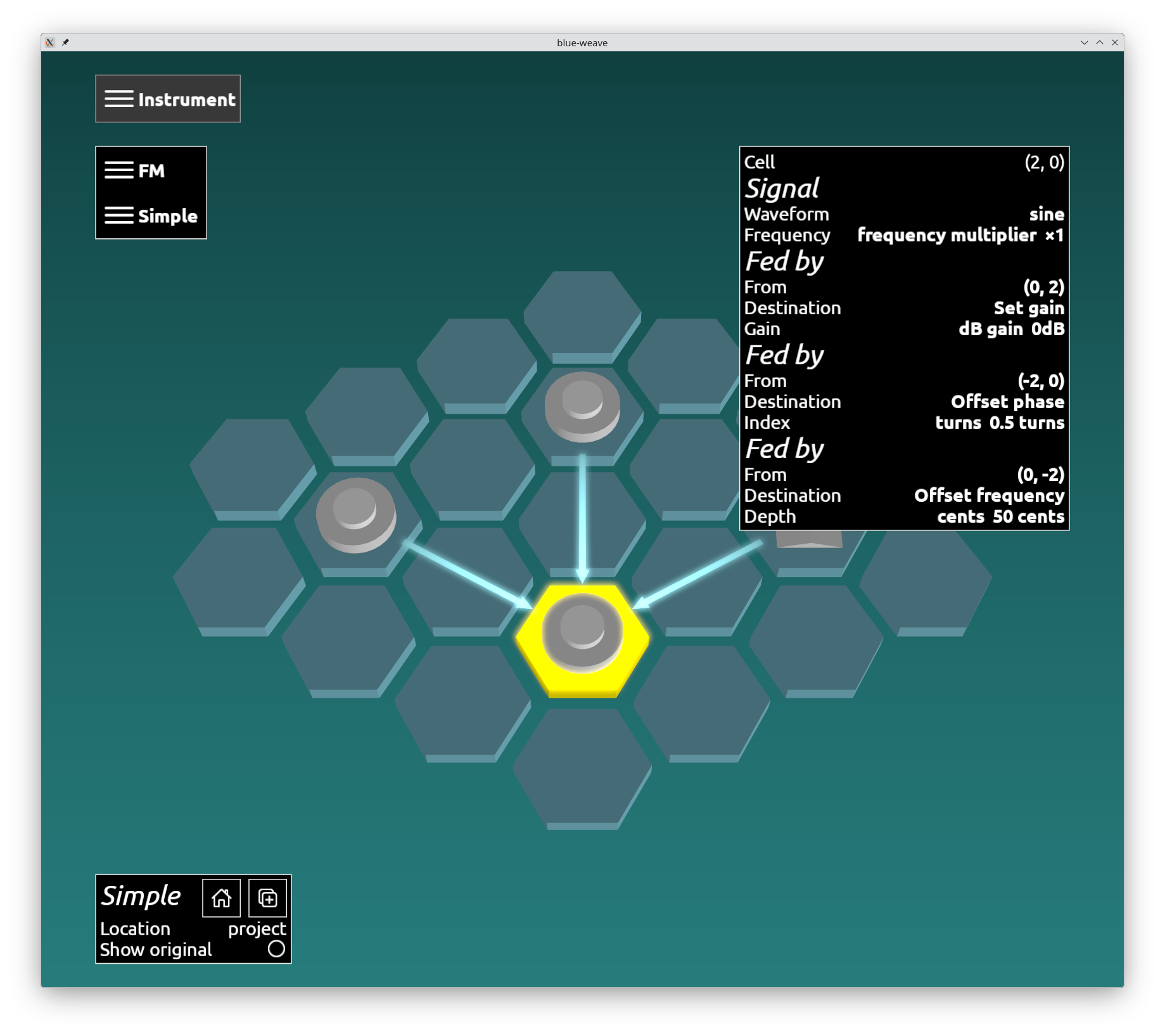
Blue Weave is a sound design sandbox: a synthesiser you build rather than one you buy. You'll get the parts, an empty hex grid, and no opinion whatsoever about how they ought to be connected. Put a block down, wire it to another, press the space bar, and listen to what you did.
We started with additive and subtractive sounds — it turns out you can do a lot with those. We were specifying these through simple text files that looked like this:
# Explosion non-kill hits
adsr 5ms 3dB 100ms -12dB 0ms 0dB 300ms
pink 1x count=1000
bell 1x 1o 15dB
#low-pass 8x 1o -6dB

adsr 5ms 0dB 50ms -12dB 0ms 0dB 150ms
pink 2x count=1000
bell 2x 1o 15dB
And this is a live sound used in Zeta 6 Survivors (because we've embedded the sound production side of the synth into the game). It's an evolving background sound that telegraphs there's a loot goblin on the map:
# Breath layer: wider noise band, softer, slow fade after ascension
adsr 300ms 0dB 200ms -6dB 600ms 0dB 8000ms
whistle 1x 150c -12dB
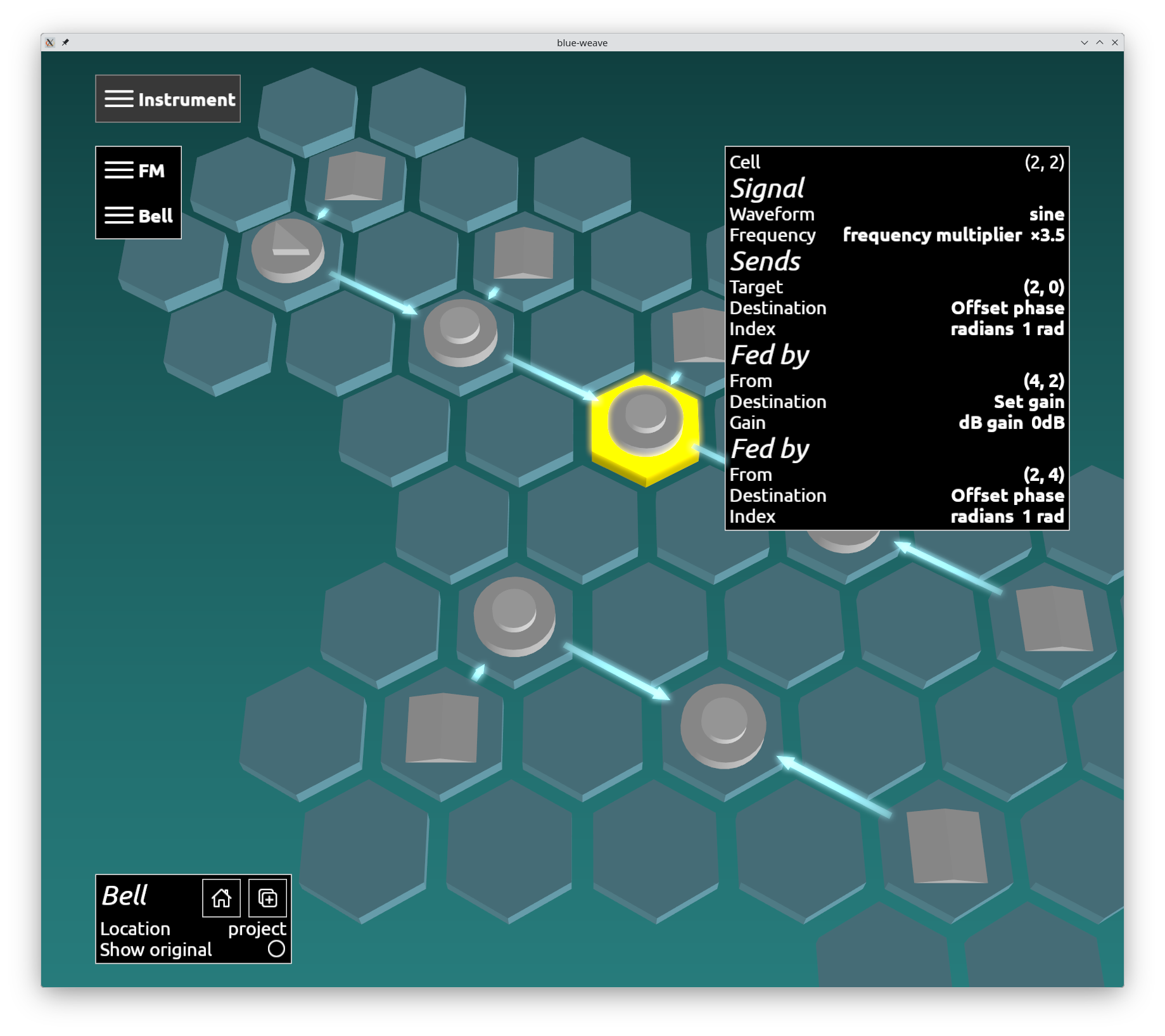
This simple layering is fine for additive and subtractive sounds, but for FM, things get a lot more complex — and a lot of the sounds you most want turn out to be the ones that need it. A list of layered parts stops being enough when what matters is which part is wired to which. That meant we needed a UI, and building it is where this stopped being a tool for filling a folder with explosions and turned into the more interesting half of the work. So now we'd like to hand it to you as well.
This complexity in the connections is the whole point of Blue Weave. Famous FM synths always came with a numbered chart of layouts printed on the front panel, and whatever sound you were chasing had to turn out to be one of the shapes on that chart. Blue Weave hasn't got a chart. Any part can feed any other part, anywhere on the grid, including back around into itself — so feedback is just a wire you happened to draw rather than a feature somebody had to build you a knob for. The DX7's thirty-two layouts are thirty-two of the shapes you can make, and nothing stops you at the thirty-third.
It will run on Linux, Windows and macOS, and it will need no hardware at all — the space bar plays whatever patch you're looking at, with a MIDI controller for when you'd rather play it properly. What you build will export to FLAC or OGG Vorbis, which is where all this started: sounds for our games, made by us, and then by you. You'll set the note it renders at, so working through the notes you need leaves you with a set rather than a single file.
0.1 isn't out yet, so there's nothing to download today. The Blue Weave page has what's coming in 0.1, what arrives by 1.0, and rather more detail for anyone who has ever lost an evening to an operator chart.